

A 7-Eleven night shift job in Japan pays at least ¥1,600 an hour in Tokyo right now. The capital's minimum wage rose to ¥1,280 on October 1, 2026, and night work legally adds 25% on top.
Nobody at the store is doing you a favor with that rate. Article 37 of Japan's Labor Standards Act requires the premium for all work between 10 p.m. and 5 a.m., at every convenience store chain.
This guide is for international students on a student visa, who can legally work only 28 hours a week during the school term. Under that cap, when you work decides how much you take home.
How Do You Apply for a 7-Eleven Night Shift in Japan?
You apply in four steps: confirm you're 18 or older with work permission, write a Japanese resume, submit it online or at the store, then sit a short interview. Most applicants move from resume to interview within about a week.
A rirekisho is the standard Japanese resume, listing your education, work history, language skills and visa status, with a passport-style photo attached. Buy the printed form at any konbini or download a template and fill it in neatly.
Should You Apply Online or Walk Into the Store?
The official 7-Eleven Japan website lists part-time openings you can filter by shift time, location and wage. Online applications usually trigger a confirmation email, then a wait.
I'd still print the rirekisho, clip on the passport photo, and hand it to the store manager in person, since paper applications given directly often get a faster review than the online queue.
Most 7-Eleven stores in Japan are franchises, so the owner you meet at the counter is usually the person who hires. Ask when they're free, keep it short, and smile.
What Happens After the Interview?
Interviews stay practical: which nights you can cover and how much Japanese you speak. Reliability matters more than retail experience, so say clearly which nights you can commit to every week.
Once hired, you get brief training on the cash register, store safety and cleaning routines, plus emergency steps. Bring your residence card again, because the store will likely check your visa status at this stage.
Who Can Legally Work Nights at a Japanese 7-Eleven?
Workers must be 18 or older, because Article 61 of Japan's Labor Standards Act bars anyone under 18 from working between 10 p.m. and 5 a.m. No store can bend this rule for a mature 17-year-old.
Foreign residents also need a residence status that allows the work. A work-eligible visa covers it, and a student visa covers it only with an extra permission attached.
The 28-Hour Rule for Student Visa Holders
Students need the Permission to Engage in Activity Other Than That Permitted, normally stamped on the back of the residence card. No stamp means no legal job, night or day.
The permission allows up to 28 hours a week during term, counted across every job you hold combined. Going over can cause problems when you apply to renew your visa.
The Immigration Services Agency of Japan publishes the current rules for long school breaks and work limits. Check it yourself instead of trusting a coworker's memory.
How Much Japanese Do You Need for the Night Shift?
Some stores accept basic Japanese, though night staff have fewer coworkers to ask for help. Expect to handle payments and the occasional emergency in Japanese, often on your own.
If your level is shaky, practice the standard register phrases and counting in yen until they come out without thinking. Store owners notice that effort in the interview.
How Much Does a 7-Eleven Night Shift Pay in 2026?
A Tokyo night shift at 7-Eleven pays at least ¥1,600 an hour between 10 p.m. and 5 a.m., which equals the new ¥1,280 Tokyo minimum plus the legal 25% premium. Stores can set rates above that floor.
Rates outside Tokyo start lower because each prefecture sets its own minimum. Hokkaido, for example, moved to ¥1,131 an hour on October 1, 2026, so its night floor sits near ¥1,414.
| Shift type (Tokyo) | Legal premium | Minimum hourly rate |
|---|---|---|
| Daytime | None | ¥1,280 |
| Night, 10 p.m. to 5 a.m. | 25% | ¥1,600 |
| Night overtime, past 8 hours in a day | 50% | ¥1,920 |
Night overtime stacks both premiums, so every hour past your eighth on a night shift pays half again the daytime rate.
Why the Night Shift Matters More Under a 28-Hour Cap
A student working all 28 legal hours in Tokyo earns ¥35,840 a week on days and ¥44,800 on nights. The gap is ¥8,960 a week, or about ¥35,840 over four weeks.
Put plainly, night work adds roughly one extra week of daytime pay every month without a single extra hour on the clock. Your visa limits hours, so the hourly rate is the only dial left to turn.
I think this is the one solid financial reason for a student to choose nights: the 28-hour limit fixes your time, and the 25% premium is the only legal way to stretch it.
Watch the 5 a.m. Cutoff on Night Pay
The 25% premium stops at 5 a.m. A shift from 10 p.m. to 6 a.m. pays the night rate until five and the standard rate for the final hour.
Check your payslip line by line during the first month. Ask the owner how break time is counted, since unpaid breaks come out of your total.
What Does a 7-Eleven Night Shift Worker Do?
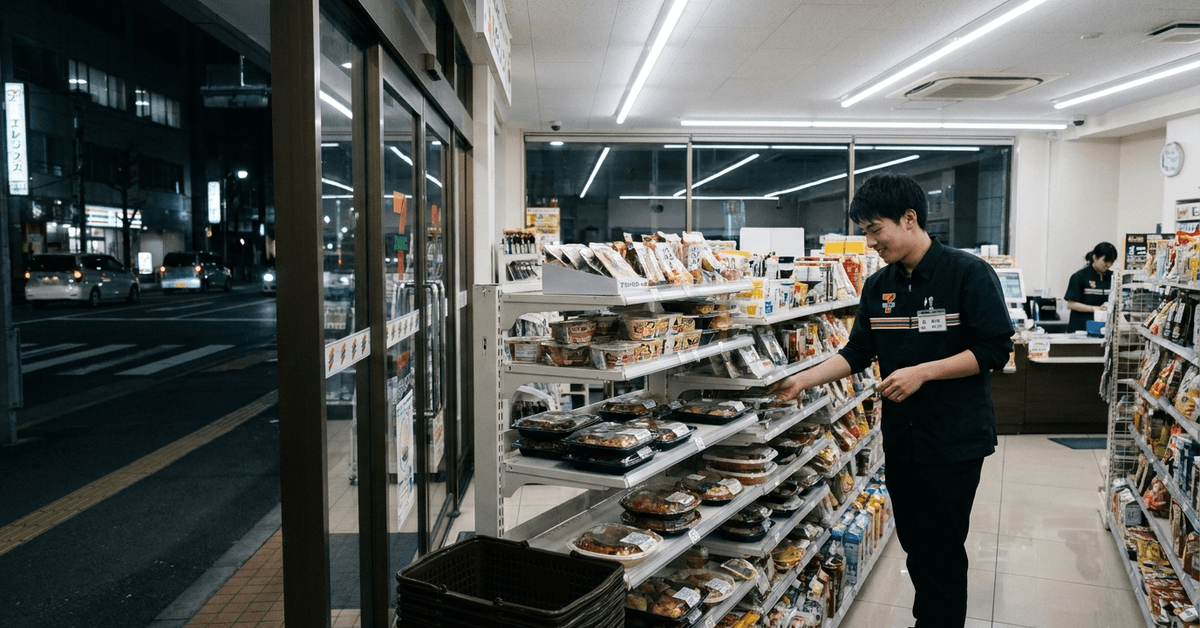
Night staff at 7-Eleven run the register, restock overnight deliveries and clean the store, often with only one or two people on duty for the whole shift.
A typical overnight routine at a Japanese 7-Eleven includes:
- Shelving overnight deliveries and pulling items past their expiry date
- Running the register, including mobile and cashless payments
- Cleaning floors, restrooms and shelves throughout the shift
- Prepping food so the store is ready for the morning rush
- Calmly dealing with intoxicated customers and odd late-night requests
Is the Quiet Night Shift Easier for Beginners?
Nights get sold as the calm shift for newcomers. Fewer customers walk in, so the reasoning goes that a beginner can learn at an easy pace.
I'd start a first konbini job on day shifts anyway, because a night crew of one or two people has no senior coworker nearby when the register jams or a drunk customer starts arguing.
Daytime is busier, yet you learn the register and emergency steps with a full team around you. Move to nights once those routines feel automatic.
What Should You Check in a 7-Eleven Night Shift Contract?
Japan's Labor Standards Act requires a 45-minute break for shifts over six hours and a 60-minute break for shifts over eight hours. Your written contract should show your breaks, hourly rate and shift times.
Go through these points with the store owner before your first night:
- The hourly rate from 10 p.m. to 5 a.m., and the rate after 5 a.m.
- How long your break is and whether it's paid
- Your total weekly hours across all jobs, if you hold a student visa
- Whether transport costs or meal discounts are included
- Who to call when something goes wrong mid-shift
Taxes on Part-Time Night Pay
Most stores withhold income tax from each paycheck automatically. If you hold two part-time jobs, you may need to file your own return, so keep every payslip and the year-end gensen choshuhyo withholding slip.
Residence tax (juminzei) may be billed the following year based on this year's income. Setting aside a slice of the night premium each month keeps that bill from becoming a surprise.
The Sleep Bill Comes Due Too
Regular night shifts flip your sleep schedule, and the fatigue builds slowly. Your body, sadly, does not receive a 25% premium.
If you have morning classes, map them against your shift calendar first. A 6 a.m. finish followed by a 9 a.m. lecture is a schedule designed to fail.
Questions People Ask About 7-Eleven Night Shift Jobs in Japan
These are the questions students tend to ask once the pay math starts looking tempting.
- Q: Can foreigners work the night shift at 7-Eleven in Japan?
Yes, as long as you're 18 or older and your residence status allows work. Students need the work permission stamp and must stay within 28 hours a week across all jobs. - Q: How many night shifts can a student work per week?
Three shifts of eight working hours add up to 24, leaving four hours of room under the cap. A fourth full night would push you past 28, so plan your schedule around that number. - Q: Does 7-Eleven pay more at night than FamilyMart or Lawson?
The 25% night premium is required by law at every chain, so it won't separate one store from another. Compare base hourly rates and transport allowances instead, since those vary by owner. - Q: How fast can I start working after applying?
Interviews usually come within about a week of applying. Training follows soon after hiring, so having your rirekisho and residence card ready speeds things up. - Q: Can I work the night shift if I'm 17?
No. Japanese labor law bans workers under 18 from working between 10 p.m. and 5 a.m., so stick to daytime shifts until your birthday.
Conclusion
A 7-Eleven night shift in Japan pays a legal premium, yet the real advantage depends on your visa. Students capped at 28 hours a week gain the most, since every night hour earns 25% more.
Print your rirekisho, check your residence card permission, and read the contract line by line before signing. Then ask yourself one question: can your sleep schedule survive the hours your bank account is asking for?