
A card loan from SMBC tops out at 14.5% annual interest. Consumer finance lenders like Acom and Promise charge up to 18.0%. That 3.5 percentage point gap adds up to tens of thousands of yen on a ¥500,000 balance held for a year.
Most guides about borrowing in Japan spend their opening paragraphs ranking lenders by speed. They treat same-day disbursement like a dealbreaker. But the reason someone pays more in total interest rarely gets the same attention.


This article is written for residents in Japan, including foreign nationals on work visas, who need a personal credit line and want to understand why SMBC's card loan works the way it does before applying.
The Rate Gap Between SMBC and Consumer Finance Lenders
SMBC's card loan uses a tiered rate structure. The bank assigns a rate between 1.5% and 14.5% per year based on your approved credit limit and screening results. A higher approved limit brings a lower rate.
Consumer finance companies like Acom (owned by MUFG) and SMBC Mobit (part of the same SMBC Group) charge up to 18.0%.
That gap of 3.5 percentage points looks small on paper. On a ¥1,000,000 balance carried for 12 months, the difference in interest cost is roughly ¥35,000.
How the Rate Is Assigned
The bank does not publish a fixed rate table where a specific income level locks in a specific percentage. The screening process considers your employment type, income stability, existing debts, and the amount you request.
Asking for a lower limit generally improves the chance of landing a lower rate within that 1.5% to 14.5% band.
I would start any card loan application at SMBC by requesting only the amount I need. A ¥500,000 request gets screened differently than a ¥3,000,000 request, and the rate assignment tends to reward conservative asks.
Japan's Income Cap Rule and Why Bank Card Loans Skip It
Japan's Money Lending Business Act (貸金業法) includes an aggregate lending cap called sōryō kisei (総量規制).
Under this rule, regulated consumer finance lenders cannot issue unsecured loans totaling more than one-third of your annual income across all such lenders combined.
A person earning ¥4,500,000 per year can borrow a maximum of ¥1,500,000 total from consumer finance companies like Acom, Promise, and SMBC Mobit.
Bank Card Loans Are Exempt
SMBC's card loan is a bank product, not a consumer finance product. Bank-issued card loans fall outside the sōryō kisei cap entirely. That means the one-third income limit does not apply.
This is the single biggest structural advantage of a bank card loan, and almost no English-language comparison covers it. Someone earning ¥4,500,000 might get approved for ¥2,000,000 or more at SMBC, depending on screening results.
The same person hits a hard ceiling of ¥1,500,000 at any consumer finance lender.
Who Benefits the Most
The exemption matters less if your borrowing needs stay under a few hundred thousand yen. It matters a lot for freelancers, dual-income households, or anyone consolidating multiple small debts into one line.
My take: the common suggestion to just grab a consumer finance loan for convenience ignores this structural difference.
If your planned borrowing exceeds ¥1,000,000, the SMBC card loan's exemption from the income cap and the lower rate ceiling both work in your favor. The two or three business days of extra wait time cost less than years of higher interest.
SMBC Card Loan Eligibility and Application Steps
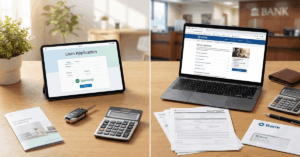
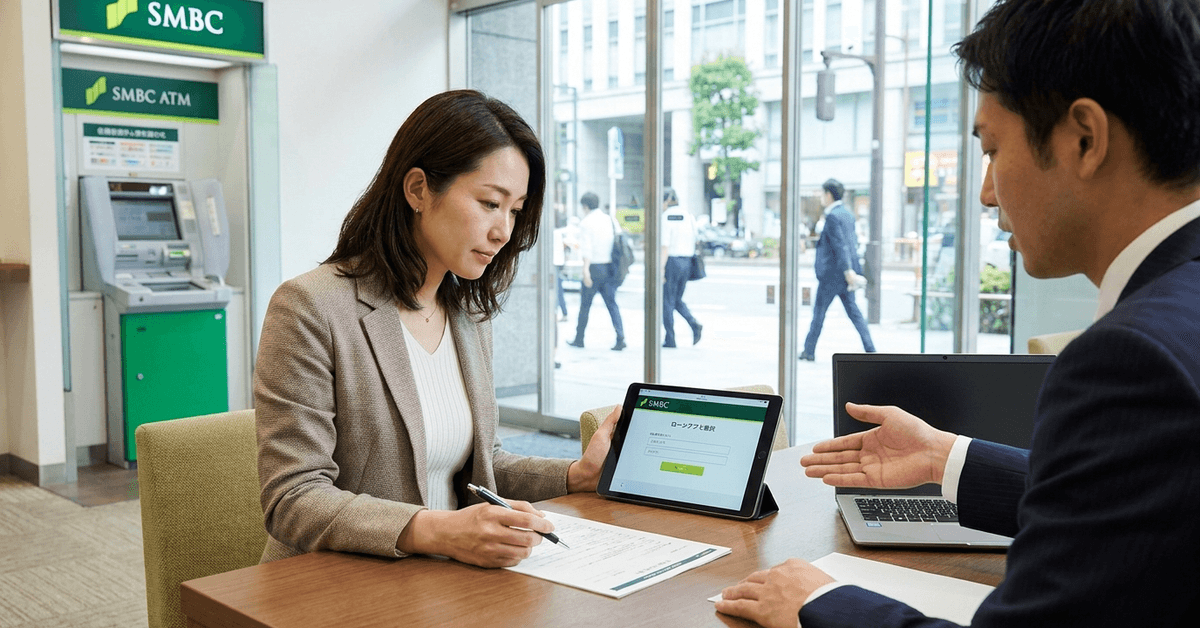
The application process runs through SMBC's website, the official card loan app, or at branch ATMs. The bank accepts applicants who do not hold an existing SMBC bank account.
Basic eligibility breaks down like this:
- Age: 20 to 69 years old at the time of application
- Income: Stable income required, though self-employed applicants can qualify based on financial records
- Residency: Japanese nationals and foreign residents with valid residence cards are eligible
- Guarantor: None required (SMBC Consumer Finance acts as the guarantor company)
Documents and Screening Timeline
Prepare a valid ID (residence card for foreign nationals, driver's license or My Number card for Japanese nationals) and proof of income if the requested amount exceeds a certain threshold.
Screening typically takes one business day, though delays can happen if the bank needs to verify employment details or documentation. One thing to know: bank card loans in Japan cannot disburse funds on the same day you apply.
This is an industry-wide rule among Japanese banks, not an SMBC-specific limitation. Consumer finance arms like SMBC Mobit can offer same-day funding because they operate under different regulations.
Credit Bureau Checks
SMBC reports to and checks all three Japanese credit bureaus: CIC, JICC, and KSC. A single application inquiry will not damage your credit profile in any meaningful way.
But submitting applications to five or six lenders within a few weeks creates a pattern that screening systems flag. Foreign residents arriving in Japan start with zero domestic credit history, regardless of their credit records abroad.
The Japanese bureaus do not import foreign data. Building even six months of clean domestic payment history, through a phone contract or utility payments, strengthens a card loan application.
SMBC Card Loan Repayment and ATM Access
Repayment happens through two channels: scheduled monthly payments debited automatically, and temporary repayments you make voluntarily at any time to pay down the balance faster.
| Feature | SMBC Card Loan | Consumer Finance (Acom/Promise) |
|---|---|---|
| Interest Rate Range | 1.5% – 14.5% | 3.0% – 18.0% |
| Max Borrowing Limit | ¥8,000,000 | ¥5,000,000 (Acom) |
| Same-Day Funding | No | Yes |
| Subject to Income Cap | No | Yes (1/3 annual income) |
| Late Payment Penalty | 19.94% | 20.0% |
The penalty rate for missed payments is 19.94% at SMBC. That rate kicks in from the day after the missed due date. Setting up automatic deductions from a bank account removes the risk of forgetting.
Free ATM Access at Convenience Stores
Borrowing and repaying at Seven Bank (7-Eleven), Lawson, and FamilyMart ATMs costs zero fees. The ATMs operate nearly 24/7, minus system maintenance windows.
One exception: Ministop locations use AEON Bank ATMs, which are not compatible with the SMBC card loan. If Ministop is your closest convenience store, plan around this gap.
Temporary Repayments Have a Quirk
Making a temporary (extra) repayment before your scheduled due date does not replace that month's required payment. It carries the scheduled payment forward to the next month.
This sounds minor, but it catches borrowers off guard. If you make an extra payment on the 10th and your scheduled payment date is the 25th, the system may count the next due date as the following month.
Check the repayment calendar in the SMBC card loan app after every temporary payment to avoid surprises.
Mistakes That Slow Down or Kill an Application
Some errors are common enough to mention directly:
- Mismatched address details between your residence card and application form
- Requesting the maximum limit without income documentation to support it
- Applying to multiple bank card loans within the same two-week window
- Listing unstable or short-term contract employment without supplementary income proof
The screening algorithm weighs consistency. A clean, modest application that matches your documentation clears faster than an ambitious one full of gaps.
Questions People Ask About SMBC Card Loans
These are questions that come up frequently when researching SMBC card loans in Japan.
- Q: Can I get an SMBC card loan without a Sumitomo Mitsui bank account?
Yes. The bank accepts applications from people who do not hold an SMBC deposit account. The official app and SMBC's card loan page both allow account-free applications. Approval and disbursement may take slightly longer without an existing account relationship. - Q: How long does SMBC card loan screening take?
Screening results usually arrive within one business day. Some applications take longer if the bank needs to verify employment or request additional documentation. Same-day disbursement is not available at any Japanese bank card loan product. - Q: Can foreign residents in Japan apply for the SMBC card loan?
Foreign nationals with a valid residence card and stable income can apply. The bank checks domestic credit history through Japanese bureaus, so building local payment records before applying helps. The Financial Services Agency of Japan oversees lending regulations that protect all borrowers equally.
Conclusion
The SMBC card loan charges less interest than consumer finance alternatives and sits outside Japan's income-based borrowing cap. The tradeoff is a one-to-two business day wait for screening results instead of same-day cash.
For borrowers planning to carry a balance beyond a single month, that patience pays for itself in lower costs. The rate gap, the higher possible limit, and the free convenience store ATM access make this a product worth the short wait.