
Miss your 15-day filing window after a birth or move, and Japan's child allowance doesn't backdate. That's ¥10,000 to ¥30,000 per child per month, gone for every month you're late.
Most English-language guides treat Jidou Teate as a simple municipal perk. They list the amounts, mention the ward office, and move on. The part they skip is timing: how the filing clock starts, how it resets when you change cities, and how the 2024 reforms changed almost every number.



This article is for the expat parent in Japan who just had a baby, just relocated, or just found out this benefit exists three months too late.
The 2024 Overhaul Changed Everything About Jidou Teate
Starting in December 2024, Japan removed income limits entirely and extended eligibility from middle school to high school age.
That single reform turned Jidou Teate from a means-tested supplement into a universal benefit for every family raising children under 18.
Two changes matter the most for your monthly deposit.
New Monthly Amounts After October 2024
The payment structure now splits into two tiers based on birth order, not income.
| Child's Age | 1st and 2nd Child | 3rd Child and Above |
|---|---|---|
| Under 3 years old | ¥15,000/month | ¥30,000/month |
| Age 3 through high school graduation | ¥10,000/month | ¥30,000/month |
A family's third child now receives ¥30,000 per month regardless of age bracket. That's ¥360,000 per year per child for families with three or more kids.
How Japan Counts "Third Child" (This Trips People Up)
Children are counted as a first child until the end of the school year they turn 22. So if your oldest is 20 and in university, your youngest still counts as the third child and qualifies for the ¥30,000 rate.
The moment that oldest child's school year ends after turning 22, the counting shifts down. Your former "third" child becomes a "second" child. The monthly amount drops from ¥30,000 to ¥10,000 overnight.
I think this counting rule is the single most underdiscussed detail in every Jidou Teate guide written for foreigners in Japan, because a ¥20,000 monthly drop tied to a sibling's age catches families off guard.
Payment Schedule: Six Times Per Year Now
Payments are now distributed six times per year, on the 10th of every even-numbered month. That means deposits hit in February, April, June, August, October, and December. Each payment covers the previous two months.
The old system paid three times per year with four-month gaps between deposits. If your bank shows three annual deposits, your municipality may still be transitioning to the new schedule.
The 15-Day Rule That Costs Expats Real Money
The filing deadline is the single most expensive detail expat parents overlook. After a birth or move, the application must be submitted within 15 days starting the day after the event.
File on day 16 and your payments begin the following month, not the current one. For a family with two children under three, that's ¥30,000 lost for one missed month. For a family with a third child, it's ¥30,000 for that child alone.
Births Near the End of the Month
If the birth or move-in date falls close to the end of a month, and the application is submitted in the following month but still within 15 days, payments start from the application month.
This grace period exists specifically for end-of-month births, but ward office staff don't always explain it in English.
A baby born on January 28 gives you until February 12. File by then, and your February payment counts. File on February 13, and February is gone.
City-to-City Moves Reset the Clock
Moving between municipalities requires a new application at the new city or ward office. The 15-day window restarts from your move-in date. Plenty of expat families treat an inter-city move as an address update, not a new application.
The result: a gap of two or three months with no payments, followed by a confusing letter requesting repayment of overpaid amounts from the old city.
I would prioritize the ward office visit above unpacking boxes, above setting up internet, above everything except submitting the tenshutsu todoke (moving-out notice) at the old address and the tennyuu todoke (moving-in notice) at the new one.
Documents and the Ward Office Visit
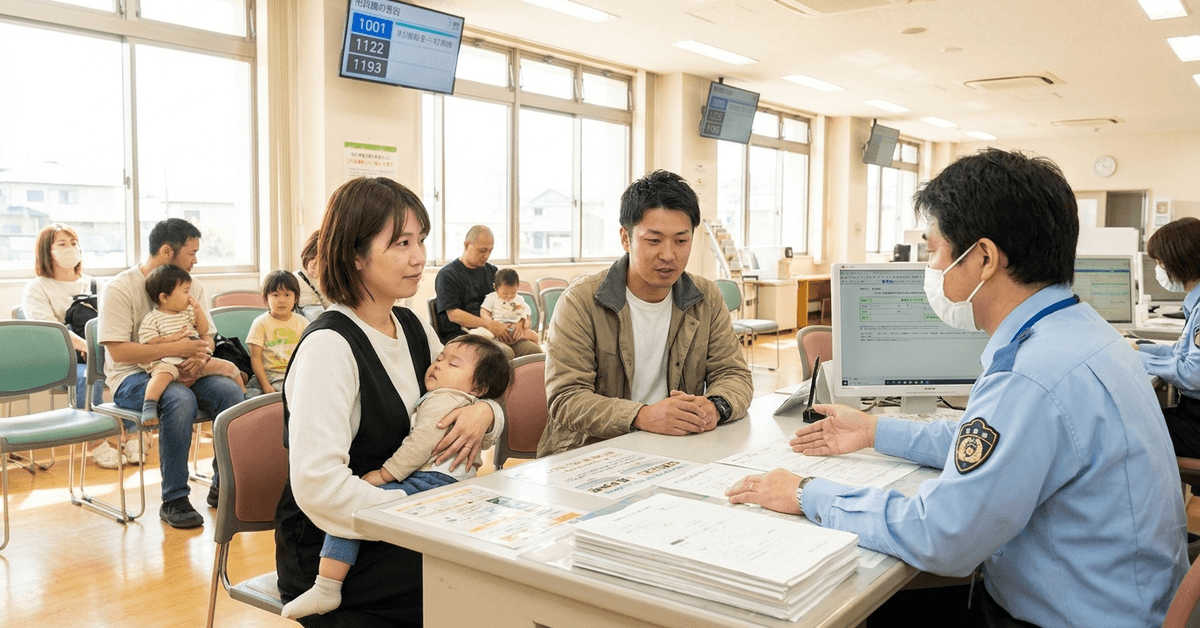
Every municipality handles Jidou Teate through its shiyakusho (city hall) or kuyakusho (ward office). The application process is paper-based, and English support ranges from full bilingual forms in Tokyo's central wards to nothing at all in smaller cities.
Bring these to your first visit:
- Residence card (zairyu card) or My Number card for the applicant
- My Number for both the applicant and the child
- Bank account details in the applicant's name (Japanese bank account required for direct deposit)
- Juminhyo (residence certificate), though some offices pull this internally
- Health insurance card for the applicant
A missing document means a second trip. Ward offices in smaller cities often close at 5:00 PM sharp, and afternoon lines can eat 45 minutes. Call ahead. Some offices accept partial submissions and process the rest by mail.
Public Servants File Differently
If the applicant is a public servant (national or local government employee), the application goes through the employer's office, not the municipal office.
This is a separate track that most English-language guides don't mention. Government employees who file at the ward office get redirected.
What Happens When Life Changes
Japan's system assumes stability, but families move, separate, and change guardianship. Each of these events triggers a reporting obligation.
Situations that require notification to your ward office:
- Address change within the same municipality: update only, no new application needed
- Moving to a different city: full reapplication at the new location within 15 days
- Divorce or change in guardianship: the parent with custody and higher income becomes the new applicant
- Child moving abroad: eligibility generally ends, though short-term study abroad or a parent's overseas work assignment may qualify for exceptions
Failing to report a change doesn't pause the system. Payments keep going to the old applicant at the old address.
The municipality will eventually catch the discrepancy and send a repayment demand. That demand can arrive six to twelve months later, covering the entire overpaid amount.
2026 Reforms Happening Alongside Jidou Teate
The child allowance reform didn't happen in isolation. Starting April 2026, a new surcharge on health insurance premiums funds Japan's broader anti-birth-decline package. Workers earning ¥6 million annually pay about ¥575 per month toward this surcharge.
Also from April 2026, parents can enroll children aged six months to three years in daycare for up to 10 hours per month, even if neither parent works full time. The estimated cost is about ¥300 per hour.
Private high school tuition support has also been expanded, with the income cap removed entirely and annual support payments reaching ¥457,000 for full-time students at Japanese schools. International schools remain outside this program.
These overlapping changes mean the total value of Japan's child support package in 2026 extends well beyond the monthly Jidou Teate deposit.
Questions People Ask About Jidou Teate
A few questions come up repeatedly among expat parents filing for the first time.
- Q: Can I receive Jidou Teate if I'm on a spouse visa?
Absolutely. Visa type doesn't determine eligibility. Any parent or guardian registered as a resident of a Japanese municipality with a valid residence status can apply. The child needs to be living in Japan and registered at the same (or a nearby) address. - Q: Do both parents receive the allowance?
No. Only one parent receives the payment, and it's typically the one with higher income. If both parents earn roughly the same, the municipality decides based on tax records. Divorced parents should confirm which parent is listed as the applicant, because the default doesn't always switch automatically. - Q: Does the ¥30,000 third-child rate apply if my oldest is already an adult?
It depends on age and enrollment status. The oldest child counts in the sibling order until the end of the fiscal year they turn 22. After that cutoff, the remaining children shift down in the birth-order count, which can reduce monthly payments.
Conclusion
The Japanese Ministry of Health, Labour and Welfare posts official guidance in Japanese. For English summaries of the 2026 fiscal year changes, Nippon.com's overview covers the broader policy package.
Japan's child allowance system pays real money to every registered family, regardless of income, through high school graduation. The amounts are modest individually, but across 18 years they add up to over ¥2 million per child.
Filing on time, reporting every move, and understanding the sibling counting rule are the three things that separate families who collect the full amount from families who leave months on the table.