
A single person in Tokyo on seikatsu hogo receives roughly ¥130,000 per month in living expenses, plus a separate housing allowance capped around ¥53,700. That combination barely covers rent and food in most of the 23 wards.
And yet only about 20% of people who would qualify for livelihood protection in Japan ever apply for it. The gap between eligibility and actual use is enormous, especially among foreign residents.



This guide is for anyone on a long-term visa in Japan who has lost income, burned through savings, and needs to understand whether seikatsu hogo is a real option or a dead end. The answer depends on your visa status, your ward office, and a few details that most English-language guides skip entirely.
Foreigners and Seikatsu Hogo: Who Can Apply?
The Livelihood Protection Act, technically, applies only to Japanese nationals. That sentence alone scares off thousands of foreign residents who might otherwise qualify. But the practice is different from the statute.
The "Administrative Measure" Loophole
The law defines its coverage as Japanese citizens. Foreign nationals receive seikatsu hogo as an "administrative measure" based on humanitarian grounds, not as a legal right. A 2014 Supreme Court ruling confirmed this distinction.
Local governments can provide welfare to non-Japanese residents. They do not have to.
Eligible visa categories include permanent residents, spouses of Japanese citizens, long-term residents, and those granted refugee or complementary protection status. People on work visas, student visas, or short-term stays are generally excluded.
How Many Foreign Households Receive It?
As of the 2023 fiscal year, 47,317 households headed by a foreign national were receiving seikatsu hogo, making up 2.9% of the total 1.65 million recipient households nationwide. That number has held relatively steady for several years.
The My Number Verification Change Coming in 2027
The Japanese government announced a policy shift in January 2026 that every foreign applicant should know about.
Starting in June 2027, the Ministry of Health, Labour and Welfare plans to link My Number data with residence status information. This will allow welfare offices to verify a foreign applicant's visa type through an online system.
Does This Mean Fewer Foreigners Will Be Approved?
A senior MHLW official stated the goal is not to "cut off" foreign residents but to improve accuracy in determining eligibility.
I think that phrasing from MHLW leaves a lot of room for tighter enforcement at the local level, particularly in wards where caseworkers already push back on foreign applicants.
An advocacy group called the National Conference on Livelihood Protection Issues released an emergency statement in January 2026 opposing the government's direction.
The Application Process at the Welfare Office
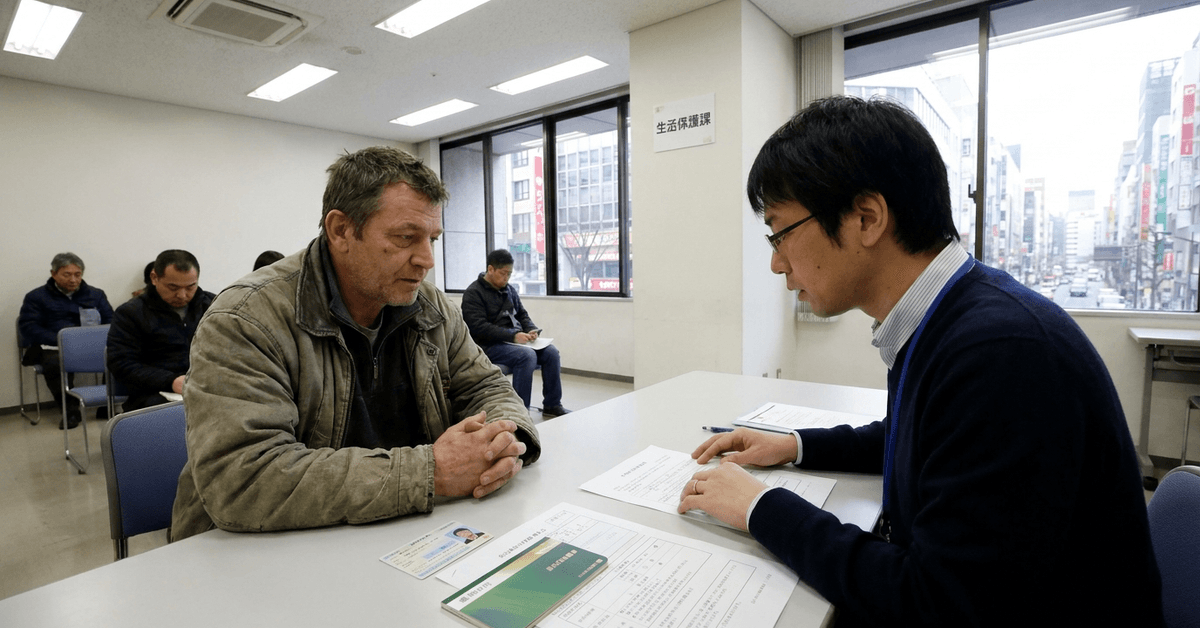
Every application starts at your local fukushi jimusho (welfare office), attached to the city or ward office. The process has several stages, and the first one is where things tend to go sideways.
The Preliminary Consultation Nobody Warns About
I would argue that the biggest barrier for foreign applicants is not paperwork but the preliminary consultation (相談, or sōdan). This is a pre-application interview where caseworkers assess your situation.
Caseworkers might suggest you borrow money from family, sell belongings, or try harder to find work. The 20% capture rate across Japan tells you how many eligible people never make it past this step.
I think the widespread advice to "just visit your ward office and apply" misses the single biggest friction point in the entire system. The sōdan is where most people give up, and bringing a support person (an NPO advocate, a social worker, a Japanese-speaking friend) changes the dynamic entirely.
Documents to Bring on Your First Visit
Once you get past the consultation and formally apply, you will need to submit proof of your financial situation. Prepare these before your first visit:
- Zairyu card (residence card) showing valid long-term status
- My Number card or notification card
- Bank statements from the past 2-3 months showing balances and transactions
- Rental contract for your current housing
- Passport and any employment or income statements you have
The caseworker will also ask about assets abroad. Savings in a foreign bank account, property in your home country, or regular remittances to family overseas all factor into the decision.
How Long the Decision Takes
Assessment periods vary by ward. Some offices respond within two weeks. Others take a month or more.
Social workers may visit your home during the review period, and they can request additional documentation at any stage: birth certificates, proof of job-seeking activity, medical records.
If approved, payments are backdated to the date of application, not the date of approval. That backdating matters if the review takes several weeks.
What Seikatsu Hogo Pays For (and What It Doesn't)
Payment amounts are not uniform across Japan. The Ministry of Health, Labour and Welfare sets a minimum living standard for each region, and the gap between what you earn and that standard determines your benefit.
| Category | What It Covers | Tokyo Single Person (Approx.) |
|---|---|---|
| Living assistance (生活扶助) | Food, clothing, daily expenses | ~¥80,000/month |
| Housing assistance (住宅扶助) | Rent, up to a cap | ~¥53,700/month |
| Medical assistance (医療扶助) | Full coverage, no co-pay | 100% covered |
| Education assistance (教育扶助) | School supplies, fees for children | Varies by age |
Medical coverage is the piece many applicants overlook. Recipients pay zero co-pay for covered medical treatment, which can be transformative for someone dealing with chronic illness or injury.
A single person in central Tokyo might receive a combined total around ¥130,000-¥140,000 per month. Move to a smaller city or rural area, and that figure drops because the minimum living standard is lower.
Can Part-Time Workers Receive Seikatsu Hogo?
Yes. Earning some income does not automatically disqualify an application. The system is designed to supplement income that falls below the minimum living standard, not to replace it.
If your part-time earnings bring in ¥60,000 per month and the minimum standard for your household and area is ¥130,000, the welfare office would cover roughly the ¥70,000 difference.
Hours and wage fluctuations complicate this calculation, and caseworkers adjust payments periodically based on reported income.
Ongoing Obligations After Approval
Recipients must report changes: new employment, changes in household composition, moving to a different address.
Regular check-ins happen every few months, and caseworkers may ask you to pursue job training or employment if you are physically able to work.
If your financial situation improves, benefits decrease proportionally. If you find stable full-time employment, benefits will eventually stop. This is not punitive. It is how the system is designed to function.
Where to Get Help in English
The Ministry of Health, Labour and Welfare website has official guidelines, but almost entirely in Japanese.
For English-language support, the Tokyo English Life Line (TELL) offers consultations, and local NPOs supporting foreign residents can sometimes accompany you to welfare office appointments.
Regional immigrant support centers exist in most major cities. Some ward offices in Tokyo, Osaka, and Nagoya have multilingual staff, though availability varies. Calling ahead to ask whether English interpretation is available saves a wasted trip.
Questions People Ask About Seikatsu Hogo for Foreigners
These are the questions that come up most often in online forums and NPO consultations.
- Q: Will applying for seikatsu hogo affect my visa renewal?
Receiving welfare is not listed as a ground for visa denial or deportation. The concern is understandable, but there is no official "record" that carries over to immigration review. Long-term residents and permanent residents apply without jeopardizing their status. - Q: Can I apply if I have a car or motorcycle?
Owning a vehicle complicates applications because the welfare office may ask you to sell it first. Exceptions exist if the vehicle is needed for work or medical appointments in areas without public transit. Each case is decided individually by the caseworker. - Q: Do I need a guarantor or sponsor to apply?
No. Seikatsu hogo applications do not require a guarantor. The caseworker may contact your family to ask whether they can support you financially, which is part of the standard "means test." But family refusal does not block your application.
Conclusion
Seikatsu hogo is not a simple system, and it was never designed with foreign residents as its primary audience.
The legal framework treats non-Japanese applicants as exceptions, processed through administrative discretion rather than guaranteed rights. Knowing the rules, bringing documentation, and arriving with an advocate changes the odds considerably.
If your situation qualifies, the system does pay out, and it pays out enough to keep a roof overhead and food on the table while you rebuild.