
Your first Japanese utility bill arrives by mail. It looks like a tax notice, covered in kanji, and the due date is two weeks away. No online portal. No English login. Just a barcode slip and a growing sense of panic.
7-Eleven bill payment in Japan runs on a system most countries abandoned years ago: walk into a store, hand over cash, get a stamped receipt. Done. The barcode slip that came with your bill is the entire transaction.
This guide is for the new expat or international student who just opened a Japanese apartment and has no idea how utility payments work here.
How 7-Eleven Bill Payment Works Step by Step
7-Eleven accepts utility bill payments at more than 21,000 stores across all 47 Japanese prefectures. The chain has been running bill collection services since 1987, according to its corporate timeline on nippon.com.
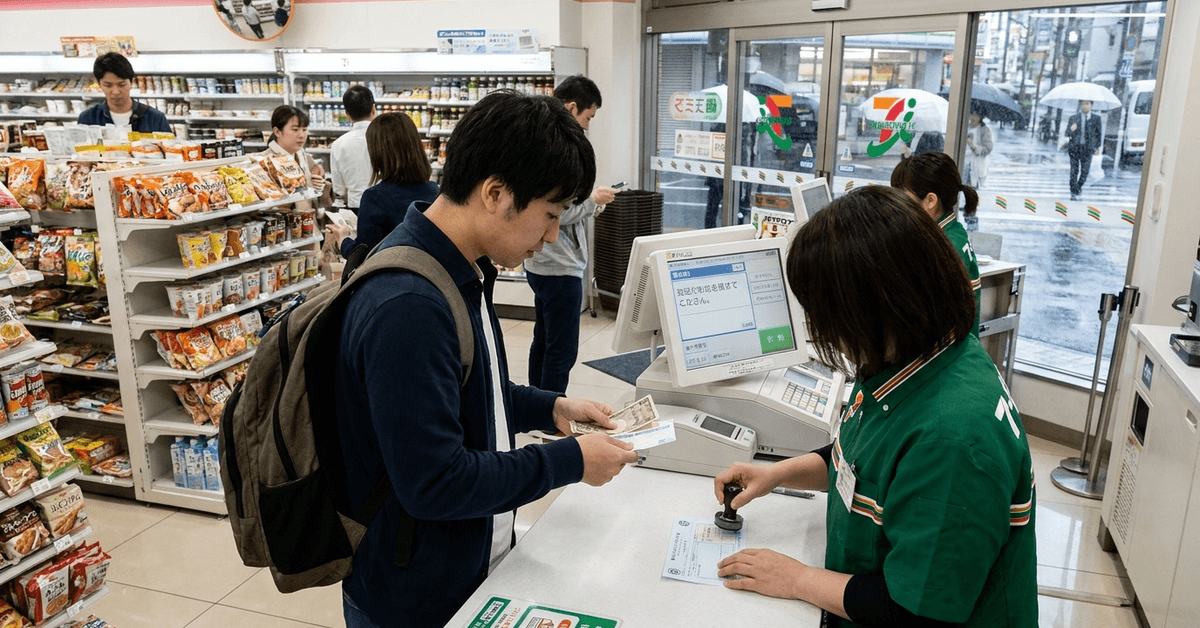
The process takes about 90 seconds. You bring the barcode slip that arrived with your gas, water, electricity, or mobile phone bill to any 7-Eleven register. The cashier scans it, you pay, and they stamp your receipt. Keep that receipt.
What You Can Pay at the Register
Utility bills cover the obvious categories: electricity, water, gas, and phone. But 7-Eleven also accepts National Pension (kokumin nenkin) payments, NHK broadcasting fees, certain municipal tax bills, and insurance premium slips.
The catch is the barcode. If your bill has one, the store can process it. If it doesn't, the cashier will decline it politely.
Cash or Nanaco Only
I think the payment method restriction at 7-Eleven is the single biggest surprise for new residents: the register accepts only cash or nanaco for bill payments. No credit cards. No debit cards. No transit IC cards like Suica or PASMO. No QR code apps like PayPay.
7-Eleven spells this out on its official bill collection page, listing every rejected method individually. Even smartphone invoice-payment features inside apps like PayPay or Line Pay do not work at the konbini counter for bills.
Nanaco is 7-Eleven's own prepaid electronic money card, issued by Seven Card Service Co.
You load cash onto a nanaco card at any 7-Eleven register or Seven Bank ATM, then tap it to pay. Nanaco purchases earn points, but bill payments through nanaco do not earn points on most utility transactions.
Paying for Online Purchases: The Konbini Payment Code
Konbini payment is a cash-at-the-counter method for online orders, available at over 50,000 convenience stores in Japan. You buy something online, choose "konbini payment" at checkout, and receive a 13-digit payment code instead of entering a credit card.
This system exists because Japan's cashless payment ratio only reached 58% in 2025, according to METI's March 2026 report. The government has set a new target of 80%, but for now, a large chunk of the population still prefers paying in person with cash.
How the 13-Digit Code Works
After placing an order on sites like Amazon Japan, Rakuten, or Yahoo! Shopping, you select konbini payment. The site generates a 13-digit number and emails it to you or displays it on screen.
Take that number to any 7-Eleven within the payment deadline. Tell the cashier or show them the code. They enter it, you pay cash, and you receive a stamped receipt.
Deadlines and Maximum Amounts
The default payment window is 7 days from the order date. Miss it, and the order cancels automatically. No extensions. No grace period.
General merchants cap konbini payments at ¥300,000 per transaction. Game and digital top-up merchants have a lower ceiling of ¥30,000. Anything above those limits requires a different payment method.
Why Your Stamped Receipt Matters More Than You Think
The stamped receipt from 7-Eleven is your only proof of payment. There is no digital record tied to your name, no confirmation email from the utility company, and no transaction history in an app.
If a utility company claims you missed a payment, that paper receipt is the only thing that settles the dispute. No receipt, no defense.
A Privacy Feature and a Risk
I think most "go paperless" advice falls apart for konbini bill payments in Japan. The anonymity of cash payment means no personal data sits at the register. No bank account linked. No name on file. For privacy, that is a genuine benefit.
But the flip side is real. Lose the receipt, and you have zero backup. I'd recommend photographing every stamped receipt the moment you get it. Store the photos in a dedicated album on your phone.
Some expat communities suggest a physical folder, too, but a photo is faster to pull up during a dispute.
Should You Switch to Autopay Instead of 7-Eleven?
Japanese banks and utility companies push autopay (jido furikae) as the modern alternative. Link your bank account, and payments deduct automatically each month. Sounds cleaner.
I would push back on that advice for anyone in their first year in Japan, specifically because of the setup friction. Opening a Japanese bank account as a new resident takes time. Some banks require six months of residency before approving an account.
Even after opening one, setting up autopay for each utility involves separate paperwork per company, often in Japanese only, with processing times of one to two billing cycles.
During that gap, your bills still need paying. 7-Eleven fills that window perfectly.
When Autopay Does Make Sense
Once your bank account is stable and you read enough Japanese to handle the forms (or have someone who can help), autopay saves you the monthly trip.
Some utility companies offer small discounts for autopay enrollment, typically ¥50 to ¥100 off per bill.
But even long-term residents keep paying certain bills at 7-Eleven. NHK fees, one-off tax slips, and insurance premiums arrive as barcode slips regardless of your autopay status.
Bill Types and Payment Methods at 7-Eleven
A quick breakdown of what works and what doesn't at the register:
| Bill Type | Cash | Nanaco | Credit Card | QR Code Apps |
|---|---|---|---|---|
| Electricity | ✓ | ✓ | ✗ | ✗ |
| Water | ✓ | ✓ | ✗ | ✗ |
| Gas | ✓ | ✓ | ✗ | ✗ |
| Mobile phone | ✓ | ✓ | ✗ | ✗ |
| National Pension | ✓ | ✓ | ✗ | ✗ |
| Online purchase (konbini code) | ✓ | ✓ | ✗ | ✗ |
The pattern is clear: cash and nanaco only, across every bill category.
Language Barriers and Practical Workarounds
You do not need to speak Japanese to pay a bill at 7-Eleven. The barcode does the talking. Hand the slip to the cashier, they scan it, and the register displays the amount.
Where language trips people up is on the bill itself. Due dates, account numbers, and payment amounts are printed in Japanese. Google Translate's camera mode can read most of it if you point your phone at the slip.
Late-Night Payments and Store Hours
Every 7-Eleven in Japan operates 24 hours a day, 7 days a week. If your bill is due tomorrow and it is 11 PM, you can still walk to the nearest store and pay. Try doing that with a bank transfer.
The one exception: some bills have a cutoff time on the due date, not just a cutoff date.
A bill due on October 15 might need payment processed before midnight on the 14th to count as on time. Check the fine print on your slip, or pay a day early to be safe.
Questions People Ask About Paying Bills at 7-Eleven Japan
New residents and travelers tend to search for the same things. A few answers that go beyond the basics:
- Q: Can I pay bills at FamilyMart or Lawson instead of 7-Eleven?
Yes. FamilyMart and Lawson both accept barcode bill payments. Lawson charges a ¥110 surcharge on bills of ¥50,000 or above, according to a 2026 fee comparison on watabi.org. 7-Eleven does not charge that fee, so it costs less for larger bills. - Q: Do I earn nanaco points when paying utility bills?
Nanaco itself does not award points on most utility bill payments. You can earn points when loading money onto your nanaco card using a linked credit card, but that is a separate transaction from the bill payment itself. - Q: What happens if I pay a bill after the deadline printed on the slip?
The 7-Eleven register will reject expired slips. You will need to contact the utility company directly for a new payment slip or an alternative payment method. Late fees vary by company. - Q: Can tourists use 7-Eleven to pay for online purchases?
Yes, as long as the online store offers konbini payment and you have the 13-digit code. No Japanese bank account or residency status is required. Just cash and the code. - Q: Is there a maximum amount I can pay at 7-Eleven for a single bill?
Barcode bill payments do not have a published per-transaction cap from 7-Eleven's side. The limit depends on the billing company. Konbini online purchase payments cap at ¥300,000 for general merchants.
Conclusion
Japan's convenience stores handle a surprising amount of financial life for a place that sells onigiri.
For a new resident fumbling through kanji-covered bills at midnight, 7-Eleven is the one system that works without a bank account, an app, or fluent Japanese. The ¥300,000 cap on konbini codes keeps larger purchases off the table, but monthly utilities fit comfortably.
Photograph every stamped receipt, pay a day before the deadline, and you will avoid the two mistakes that catch newcomers. The system is old-fashioned, a little analog, and quietly one of the most useful things about living in Japan.
References
watabi.org - Konbini Payment in Japan 2026: The 13-Digit Number
official bill collection page - 各種料金のお支払い|セブン‐イレブン