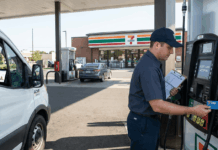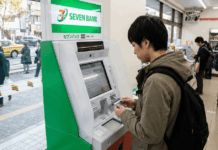

A ¥220 fee flashes on the screen of a Seven Bank ATM inside a Tokyo 7-Eleven. Seems cheap. But your bank is quietly stacking a 3% foreign transaction fee and its own ATM surcharge on top of that.
The bigger problem is the dynamic currency conversion screen that pops up mid-transaction. One wrong tap there adds another 4% to 8% markup. And the machine's interface is designed to make that wrong tap feel like the right one.
This article is for the first-time international traveler heading to Japan, Thailand, or anywhere with 7-Eleven ATMs who wants to stop bleeding fees on every cash withdrawal.
How Much Does a 7-Eleven ATM Charge Foreign Cards?
Seven Bank ATMs in Japan charge ¥110 to ¥220 per transaction for cards issued overseas, depending on the withdrawal amount and card network. Amounts under ¥10,000 typically trigger the ¥110 fee. Anything above that costs ¥220.
That fee alone looks manageable. But it only covers what Seven Bank charges on its end.

Your Home Bank's Hidden Layer
Your card issuer adds its own percentage on top. Standard bank debit cards typically charge 1.5% to 3% as a foreign transaction fee. Some also tack on a flat international ATM fee of $2 to $5 per withdrawal.
So if you pull ¥30,000 (about $200 USD) from a 7-Eleven ATM in Osaka, your real cost could break down like this: ¥220 to Seven Bank, plus $5 to your home bank, plus 3% of $200 as a foreign transaction fee. Total damage: around $12 on a $200 withdrawal.
Thailand's ATM Fee Hits Harder
Thailand runs a different playbook. Every ATM in the country charges a flat 220 baht fee (roughly $6 USD) on foreign card withdrawals.
Some machines have started displaying 250 to 350 baht for certain Mastercard transactions in 2026. Your home bank's fees get stacked on top of that, same as Japan.
Pull out 5,000 baht and the 220 baht fee alone eats 4.4% of your withdrawal. Pull out 25,000 baht and it drops to under 1%. The math changes everything about how often you should visit that ATM.
Why the DCC Screen Is the Real Fee You Should Worry About
Dynamic currency conversion (DCC) is when the ATM offers to charge you in your home currency instead of the local one. The conversion rate the machine uses is set by the ATM operator, not by Visa or Mastercard's interbank rate.
I would avoid DCC at every 7-Eleven ATM after seeing markup rates of 4% to 8% reported across Japan, Thailand, and Southeast Asia. The interbank rate your own bank uses is almost always better, even after their foreign transaction fee.
The tricky part: the DCC screen is designed to make accepting it feel natural. The button for "charge in your home currency" is often larger or positioned as the default. Always select the local currency. Always.
How to Spot and Decline DCC
The screen will ask something like: "Would you like to be charged in USD (or EUR, GBP, etc.) or in JPY?" Pick JPY. Pick THB.
Pick whatever the local currency is. If the screen shows an exchange rate and asks you to "accept," you are looking at DCC. Cancel and choose the local currency option instead.
7-Eleven ATM Withdrawal Limits for Foreign Cards
Seven Bank ATMs in Japan cap foreign card withdrawals at ¥100,000 per transaction for chip cards.
Magnetic-stripe cards get a lower limit of ¥30,000 per transaction. Daily limits depend entirely on your home bank's rules for international withdrawals, not on Seven Bank.
What Your Own Bank Might Block
Many banks set international daily ATM limits around $500 USD. If you try to pull ¥100,000 (about $670 USD) in a single transaction, your bank might decline it even though Seven Bank allows it.
The fix is to call your bank before travel and request a temporary limit increase. Some banks let you adjust this through their app.
Multiple Withdrawals Stack Fees Fast
You can hit the same 7-Eleven ATM multiple times per day. But each transaction triggers a fresh ¥110 to ¥220 fee from Seven Bank, plus whatever your home bank charges per withdrawal.
Five small withdrawals on a standard US bank debit card with 3% foreign transaction fees on a $700 total could cost $76 in fees, according to a fee breakdown published by Travel Card Index.
Two larger withdrawals on a no-foreign-transaction-fee card would cost around $12.
Which Cards Cut 7-Eleven ATM Fees the Most?
The card you insert matters more than the ATM you choose. A fee-heavy bank card at a no-fee ATM still costs you. A no-fee card at a fee-heavy ATM saves you on everything except the operator charge.
Cards worth comparing before your trip:
- Charles Schwab Investor Checking debit card reimburses all ATM fees worldwide, including the Seven Bank operator fee and the Thai 220 baht surcharge. Zero foreign transaction fee on top of that.
- Wise multi-currency debit card charges near-interbank exchange rates with a small conversion fee (around 0.4% to 0.6%). ATM withdrawals are free up to a monthly limit (varies by country), with a small fee after.
- Revolut offers fee-free ATM withdrawals up to a monthly cap. Weekend withdrawals carry a 1% surcharge regardless of plan tier.
| Card | Operator Fee Reimbursed? | Foreign Transaction Fee | ATM Withdrawal Fee |
|---|---|---|---|
| Charles Schwab Debit | Yes (all ATM fees) | 0% | $0 (reimbursed) |
| Wise Debit | No | ~0.4–0.6% conversion | Free up to monthly limit |
| Revolut | No | 0% (weekdays) | Free up to monthly limit |
| Standard Bank Debit | No | 1.5–3% | $2–$5 per withdrawal |
The Schwab card is the closest to free cash abroad. But it requires opening a brokerage account alongside the checking account.
The Credit Card Cash Advance Trap at 7-Eleven ATMs
I think the common advice to "just use your credit card" at overseas ATMs ignores a $30+ penalty most people don't see coming until their next statement. Credit card ATM withdrawals are treated as cash advances, not regular purchases.
Cash advance fees typically run 3% to 5% of the amount withdrawn, with a minimum of $5 to $10. A $300 cash advance at 25% APR costs you about $0.20 per day in interest from the moment you pull the cash.
Leave it unpaid for 30 days and that adds $6 in interest on top of the $9 to $15 cash advance fee, on top of the ATM operator fee, on top of any foreign transaction fee your card charges.
Use a debit card at 7-Eleven ATMs. Save your credit card for purchases where you get fraud protection and rewards.
Step-by-Step: Using a 7-Eleven ATM with a Foreign Card
The process at Seven Bank ATMs in Japan follows a consistent sequence:
- Insert your card (chip-side first). The machine detects the card network and switches to an English interface automatically for most foreign cards.
- Select your language. English, Chinese, Korean, and Portuguese are common options.
- Choose "Withdrawal" from the menu. Some machines label it "Cash Advance" instead.
- Enter your amount in yen. Stick to round numbers the machine can dispense.
- Decline DCC if offered. Select "Japanese Yen" as your charge currency.
- Review the operator fee displayed on screen and confirm.
- Take your cash, receipt, and card. Some Seven Bank machines hold your card for a few extra seconds after dispensing cash.
If the machine declines your card, try a different 7-Eleven location. Card readers vary in condition, and a dirty or worn reader sometimes rejects cards that work fine elsewhere.
Do 7-Eleven ATMs Work for Foreign Cards Everywhere?
Seven Bank ATMs in Japan have the strongest track record for foreign card acceptance. They take Visa, Mastercard, American Express, UnionPay, JCB, and Discover across roughly 27,000 locations nationwide.
Outside Japan, the picture changes. Thailand's 7-Eleven stores don't operate their own ATM network the way Seven Bank does in Japan.
Thai ATMs inside 7-Eleven stores belong to whatever Thai bank installed them, and they all charge the standard 220 baht foreign card fee.
Japan vs. Thailand: A Fee Comparison
A two-week trip to Japan with five ATM withdrawals on a standard bank card (3% foreign transaction fee, $5 bank ATM fee per transaction) totaling $700 costs around $76 in fees.
The same trip behavior in Thailand, at 220 baht per withdrawal plus similar bank fees, runs about $80 to $85.
Switching to a Charles Schwab Investor Checking card drops that to roughly $0 to $3 for the entire trip. The difference funds a couple of decent meals.
Questions People Ask About 7-Eleven ATMs and Foreign Cards
Should you always decline dynamic currency conversion at a 7-Eleven ATM? These are the questions travelers search for most.
- Q: Can I use a foreign Mastercard at 7-Eleven ATMs in Japan?
Yes. Seven Bank ATMs accept Mastercard, and the operator fee is sometimes waived for Mastercard transactions. Visa cards may see a ¥110 to ¥220 charge where Mastercard users pay nothing. Check the screen before confirming. - Q: What happens if a 7-Eleven ATM eats my card?
Seven Bank machines in Japan are designed to return cards after a timeout period. If the card is retained, contact Seven Bank's English support line during business hours. Outside Japan, the ATM belongs to a local bank, so you would need to contact that bank directly. - Q: Are 7-Eleven ATMs in Japan open 24 hours?
The ATMs run around the clock at most locations, but a small number of 7-Eleven stores in rural Japan close overnight. ATM services may also be briefly unavailable during early morning system maintenance windows, typically between 1:00 AM and 5:00 AM on select days. - Q: Is it cheaper to exchange cash at the airport or use a 7-Eleven ATM?
Airport currency exchange counters typically apply a 3% to 6% markup over the interbank rate. A 7-Eleven ATM with a no-foreign-transaction-fee card gives you something very close to the interbank rate for a flat ¥110 to ¥220. The ATM wins on almost every trip. - Q: Do I need to notify my bank before using a foreign ATM in Japan?
Some banks still require travel notifications. Others have eliminated the requirement entirely and rely on fraud algorithms instead. Check your bank's app or call before departure, because a frozen card at a 7-Eleven ATM at midnight in Shinjuku is a problem nobody wants.
Conclusion
The real cost of a 7-Eleven ATM withdrawal is never the number on the receipt. Your card choice, your DCC decision, and your withdrawal size control more of the total than the ATM itself does.
One good travel debit card saves more on a two-week trip than most people spend on airport coffee. Pick the card before you pick the destination, and the ATM fees take care of themselves.
References
Charles Schwab Investor Checking - Charles Schwab
Seven Bank's English support line - SEVEN BANK English Site | Seven Bank