

Sukiya pays its part-time crew around ¥1,100 to ¥1,200 per hour in most urban locations. That number sits close to Japan's national minimum wage of ¥1,121, which hit a record 6.3% increase in late 2025.
So why do thousands of foreign students still line up for a gyudon chain gig when convenience stores and warehouses pay similar rates? The answer has less to do with the paycheck and more to do with what happens between 10 p.m. and 5 a.m.



This article is for international students on a work-permitted student visa in Japan, specifically those calculating how to squeeze maximum earnings out of a strict 28-hour weekly cap.
Why Sukiya Keeps Showing Up on Every Arubaito Search
Sukiya is the largest gyudon chain in Japan, operating roughly 1,965 domestic locations as of the end of 2024, according to Zensho Holdings' latest filing.
Add the 675 international branches spread across China, Taiwan, Thailand, Brazil, and Singapore, and you get a company that posts thousands of open crew positions at any given time.
Glassdoor listed over 9,000 Sukiya job results in Japan alone as of mid-2026.
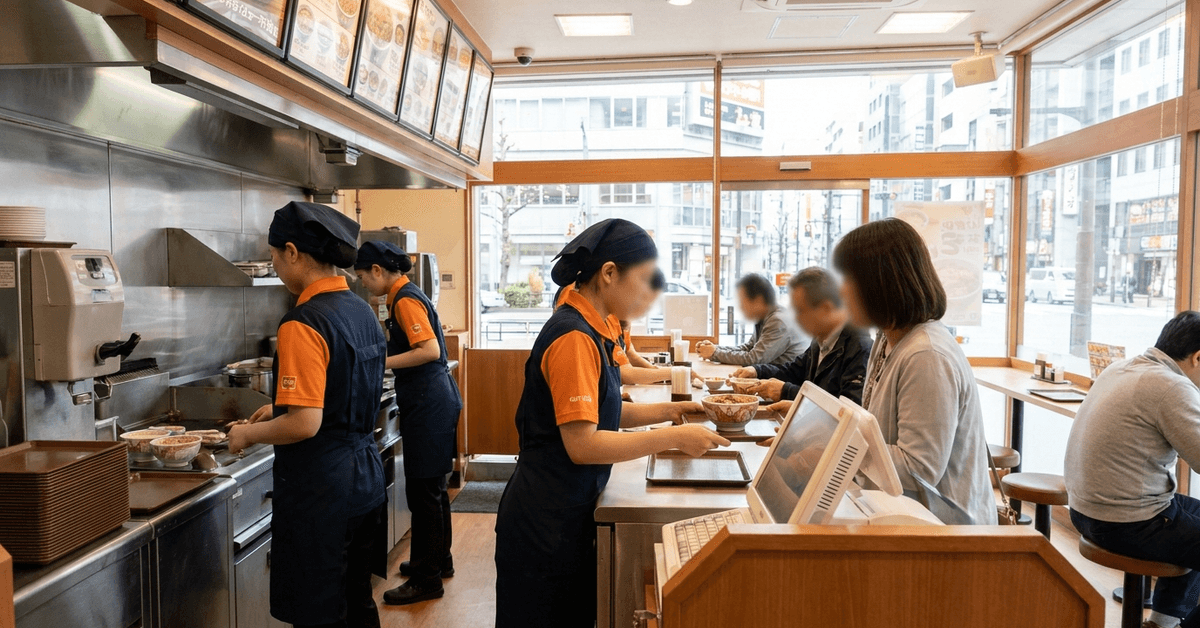
That sheer volume matters for one practical reason: location density. A student living near almost any train station in a mid-sized Japanese city can probably walk or bike to a Sukiya branch.
Commute time eats into a 28-hour weekly budget fast, so a ten-minute bicycle ride versus a 40-minute train transfer changes the monthly earnings math by ¥15,000 or more.
The Deep Night Premium Nobody Calculates Properly
Japanese labor law requires employers to pay a 25% premium for shifts after 10 p.m. This shinya teate (深夜手当) applies to every employer, but Sukiya's 24-hour operation makes it especially relevant. A base rate of ¥1,200 becomes ¥1,500 per hour after 10 p.m.
I would argue that for a student capped at 28 hours per week, stacking those hours into late-night Sukiya shifts at ¥1,500/hour can produce roughly ¥168,000 per month. That same 28 hours at a daytime convenience store rate of ¥1,121 would land closer to ¥125,500.
The catch is that late-night Sukiya shifts often run with a skeleton crew of one or two people. This has been a documented operational problem for years. The workload during a solo overnight shift includes cooking, serving, cleaning, register, and stocking.
The March 2025 Contamination Shutdown Changed the Job
Anyone applying to Sukiya in 2026 needs to know about the pest contamination crisis that shut down nearly 2,000 stores for four days in late March 2025.
A rat was found in a bowl of miso soup at a Tottori branch in January 2025, and weeks later, a cockroach turned up in a takeout order at a Tokyo location.
Sukiya closed almost every Japanese outlet from March 31 to April 4 for deep cleaning, and Zensho Holdings' stock dropped as much as 7%.
The fallout reshaped daily operations. New protocols now require refrigeration of all rubbish, regular structural inspections for gaps and cracks, and stricter food safety checks before serving.
For crew members, this translates to more cleaning tasks per shift and tighter oversight from management. If the pre-2025 Sukiya job was "make bowls, serve bowls, clean up," the 2026 version includes a longer checklist of hygiene documentation and pest prevention steps.
Sukiya Positions and Who They Suit
Sukiya splits its roles into two tracks, and the distinction matters more than most job guides suggest.
Part-Time Arubaito Roles
Team Member (Crew) is the entry-level position. Tasks cover customer orders, food prep, kitchen support, and cleaning.
No prior food service experience is required at most locations, though conversational Japanese ability is expected for front-of-house work. Kitchen-focused roles can be more lenient on language.
Shift Leader positions go to experienced part-time staff who take on cash management, floor oversight during specific periods, and team coordination. This role comes with slightly higher pay, though the exact bump varies by store.
Full-Time Tracks
I think the management trainee track at Sukiya through Zensho Holdings is underrated for foreign nationals on a work visa, because Zensho's 675 international branches create internal transfer paths that most standalone restaurants cannot offer.
| Position | Scope | Typical Requirement |
|---|---|---|
| Assistant Manager | Inventory, scheduling, HR support, bridge between crew and upper management | Prior food service or retail management |
| Store Manager | Full location P&L, hiring, performance targets, budget ownership | Internal promotion or management trainee completion |
| Management Trainee | Departmental rotation to prepare for corporate-track roles | Full-time availability and long-term career interest |
How the Sukiya Application Process Works in 2026
The hiring pipeline at Sukiya is short. Most candidates go from application to first shift within two weeks, sometimes faster at locations with urgent staffing needs.
Positions appear on the Sukiya official careers page, along with major Japanese job portals like TownWork, Indeed Japan, and Baitoru. Some stores still tape paper ads to their front windows, which is surprisingly common for a chain this size.
The steps follow a consistent pattern:
- Online or in-store application requires personal information, availability, and any prior food service background. Some regions ask for a photo attached to the application.
- Screening call or message comes within a few days. Expect brief questions about schedule availability and, for international applicants, language ability and visa status.
- On-site or video interview runs 15 to 30 minutes. Questions focus on teamwork scenarios, multitasking comfort, and willingness to work specific shift types.
- Written offer and onboarding includes pay details, expected hours, and role specifics. Training modules and shadowing shifts happen before solo responsibilities begin.
Mistakes That Slow Down Hiring
Three friction points trip up international applicants consistently:
- Not having a residence card (在留カード) and work permission documentation ready at the interview stage. Document requests happen fast after an offer.
- Listing only daytime availability. Stores filling overnight or weekend shifts move faster on candidates who mention those time slots.
- Skipping the rirekisho (履歴書), the Japanese-format resume sold at convenience stores for about ¥100-200. Even if the online application did not require one, interviewers at individual stores sometimes ask for a paper copy.
The 28-Hour Visa Trap and Tax Thresholds
Student visa holders in Japan can work a maximum of 28 hours per week during school terms, expanding to 40 hours during official school breaks. Immigration tracks these hours through employer tax reporting, and exceeding the cap is one of the most frequent reasons for student visa renewal rejection.
This limit applies across all jobs combined. A student working 20 hours at Sukiya and 10 hours at a convenience store has already exceeded the cap by 2 hours. Sukiya managers are generally aware of the rule, but double-checking the weekly schedule yourself prevents problems that surface months later during visa renewal.
On the tax side, Japan's national minimum wage increase to ¥1,121 means that a student working 28 hours per week at a rate above minimum will clear roughly ¥130,000 to ¥170,000 monthly, depending on shift premiums. Annual earnings above ¥1,030,000 trigger income tax obligations and can affect dependent status under a parent's insurance.
What Breaks and Benefits Look Like
Sukiya's benefit split between part-time and full-time is standard for Japanese food service:
- Part-time crew may receive free or discounted meals during shifts and extra pay for night or holiday work. Health insurance enrollment becomes mandatory once weekly hours consistently exceed 20 to 30 hours, depending on the employer's size.
- Full-time staff get more stable scheduling, paid leave, and pathway benefits like health insurance enrollment and potential bonuses.
- Uniforms are provided at all locations. Food safety training is mandatory and covered during onboarding.
Questions People Ask About Sukiya Jobs
Applying to Sukiya brings up a lot of practical questions that store managers don't always answer upfront. A few of the most common ones:
- Q: Can I work at Sukiya without speaking Japanese? Kitchen-only roles at some locations accept limited Japanese speakers, but most branches expect at least conversational ability for customer-facing shifts. International branches in Singapore, Thailand, or Brazil hire in the local language instead. Check the specific listing's language requirement before applying.
- Q: Does Sukiya hire 16-year-olds? Some locations accept applicants aged 16 and older for limited daytime shifts, though the standard minimum is 18. Regional labor laws and individual store policies determine eligibility. Always confirm directly with the branch.
- Q: How soon after applying do Sukiya interviews happen? Typically within a few days to a week. High-turnover locations or stores filling overnight shifts may schedule interviews within 48 hours of receiving an application.
- Q: Did the 2025 contamination incident affect Sukiya's hiring? New food safety protocols added post-closure training modules to onboarding. Crew members now spend more time on pest prevention and hygiene documentation per shift. The operational changes increased workload, which also means some stores are hiring more actively to cover the added tasks.
- Q: Is Sukiya a good first job in Japan for a foreigner? Sukiya's high volume of openings and structured training make it one of the more accessible entry points. The 24-hour operation offers scheduling variety that school-hour-only jobs cannot match. Just factor in the solo overnight shift reality before committing to late-night availability.
Conclusion
Sukiya's 2,600 global locations make it one of the easiest food service jobs to find in Japan. The late-night premium math can stretch a student's 28-hour cap further than most daytime alternatives.
Post-2025 food safety changes added real responsibilities to every shift, so the job is more demanding than older guides suggest. Pick a branch you can reach by bicycle and bring your residence card to the interview.